

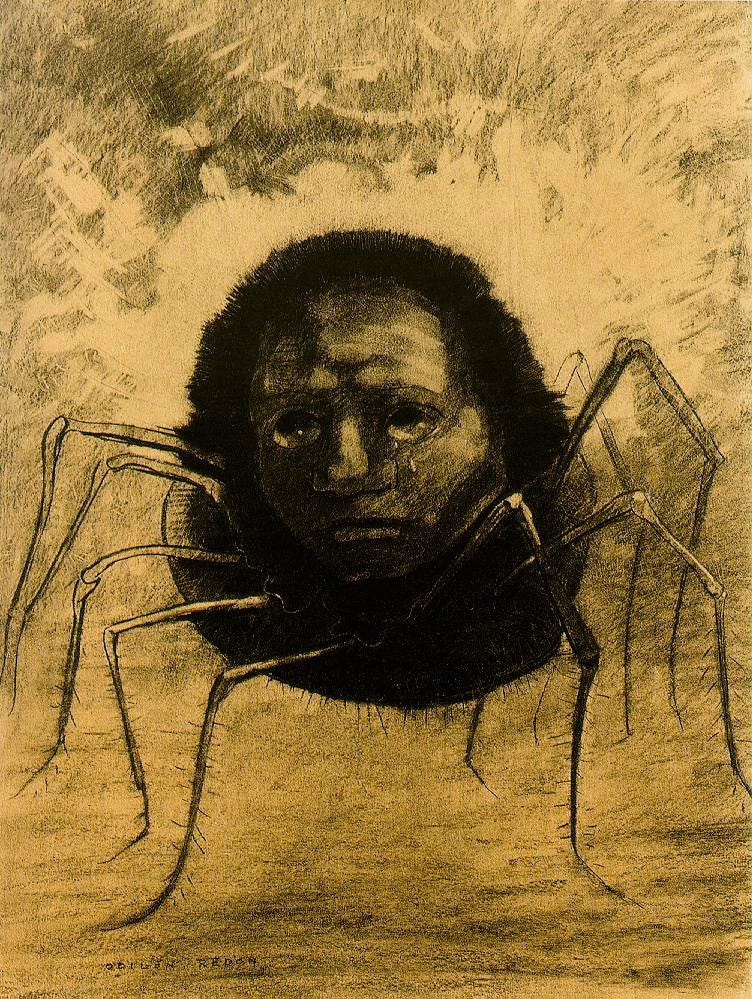
The sixth graders put on a winter play every year, and my class was slated to perform Carol’s Christmas. Think Dickens’s A Christmas Carol, but about a young girl named Carol who was gravely ill, and whose only wish was to throw a big-bash Christmas party for orphans. That night, she dies. I don’t know who picked this play, or who would enjoy watching it, and I cannot find any evidence now that it ever existed. We’ve collectively purged it from the canon. Probably wise.
Many of us auditioned for roles. It was just what you did, whether you fancied yourself a theater person or not. Because a few parts had solos, the audition meant singing in front of the entire class, a cappella. I’d never done anything like this, and I choked. I don’t think I sang a single note on pitch. But when the cast was announced, I’d landed the lead. It was controversial news, so my teacher gave me the rationale in private: “you reminded us of Carol.”
More than a lesson in show business, this was a realization of how others saw me. I didn’t feel particularly empathetic. I aspired to be a future archeologist, an Olympic athlete, or a sexy librarian—stuff that required curiosity, discipline, and cute glasses, not empathy, or at least not the emotional kind. It was a weird and uncomfortable way to see myself, middling talent but thoughtful and kind, and I didn’t love it. Meanwhile, not everyone involved in the production was convinced I deserved the part. “You’re going to have to project,” the director threatened more than once, even before we’d rehearsed, and a classmate, who was probably the best singer, informed me I was decidedly not. Waiting backstage the night of our performance, I told my teacher I felt like E.T. … an alien in the spotlight.

In a turn of events, the year after the play, the girl who said I wasn’t a good singer got sick. She was diagnosed with diabetes. I bought a gift to take to her in the hospital, and made a card myself. I drew an ice cream sundae with a cherry on top, and a big, red slashed zero over the whole thing, as if to say desserts were now banned.
My mother was horrified: “You cannot give her this card.”
Could I not imagine how it would feel? I guess I couldn’t. I felt defensive and stymied. I’d been conjuring the strength and fortitude my friend would need, not the sadness or fear she might feel. I imagined myself standing in solidarity with her, not how our life experiences were diverging. If this is how it is, then this is what we will do, I reasoned.
In the end, I didn’t give the card. My mom’s good sense overrode my inability to see the gap between intention and insensitivity, and I was flooded with shame at her rebuke.
What I didn’t know then was that empathy needs boundaries. It needs containers, and that’s what vigilance provides. It’s a protective force that prevents overreach, and the two meet at a seam of revolt or disgust, summoned by timing, or texture, or even aesthetics. Consider when you trip and fall, and lash out at the person who asks if you’re alright. That’s mismatched timing, vulnerability invoked before consent. Consider how vehemently some people dislike Las Vegas. That’s an alarm sounding that the excess is not for them. My homemade card was empathic overreach of another kind—I’d imagined my way into my friend’s experience, but I didn’t know where my imagination should stop.
One more story. A few years ago, I stumbled across the Instagram account of a woman in Australia who had a pet jumping spider named Rose. Rose lived for several years in a terrarium, and her life was witnessed by hundreds of thousands of followers all over the world. Infused with personality and a sweetish spider face, Rose would bathe in the sun, drink water from a Q-tip, and “swing” on her mom’s earring. It was all too precious, and then she began to die. Like any pet, there were good and bad days. She’d rally, then curl up on a leaf and hardly move. I know all of this because my algorithm fed me tons of Rose stories, and I would watch just to get pissed off about the empathy and tears wasted on an arachnid. I hate followed. I even recruited friends to join me—can you believe this?
At the same time, I began to wonder why I was so worked up, because there was also surprise and a sense of beauty in Rose’s story. Who cared if people loved a spider? Why had I been so sure this was empathy misplaced? Then it clicked. I was angry that people felt empathy where I had fostered vigilance.
I used to live in a house in Tucson covered in corrugated steel siding, and black widow spiders lived in the ribs. They built gauzy webs at the bottom of each, flashing their red hourglass markings in the early mornings and protecting egg sacks to spawn hundreds of offspring. I stared at them, curious and uneasy. I took close-ups and worried spider babies would fling themselves inside when I opened the front door. I named one Charlie, after Charlotte. She lived in a rib in the backyard.
One night I woke up to find a dime-sized blister on my calf. It exploded at the lightest touch, then formed a crater-like wound that took weeks to heal. I scoured the house looking for the culprit, who was likely a desert recluse, but I could have encountered the spider anywhere; earlier that day, I’d been hiking in the Sonoran Desert. I could have sat or leaned against a rock, disturbed its home. The incident pushed me from uneasy coexistence with the widows to setting a new boundary. I called an exterminator.
I remember little else about playing Carol. I learned my lines alone in the backyard on Thanksgiving day in Glendale. I remember loving my costume, which was my real Christmas dress, cream colored with a pale pink satin sash. And I was so pleased with myself that I knew to play my death subtly. For most of the performance I was confined to a big chair with a blanket on my lap. When I died after my solo, which I’m sorry to say I cannot remember at all, I simply dropped my head. The lights dimmed.
The whole time, I’d almost forgotten about the audience because I was so focused on my perceived shortcomings as an actor. But then a few days later at the bus stop, a little girl who I didn’t know came up to me and said, “I cried when you died.” I’d been so worried about projecting.
Your essays are always thought-provoking! I"m only on my first cup of coffee, but I wonder if what you're describing might involve the difference between sympathy and empathy --- like maybe empathy + vigilance ~=~sympathy? Where sympathy usually prompts someone to offer solutions, rather than just be with the person's feelings. I don't know. This is not strong coffee. But this also reminded me of a quick story: When I was 4, my older sister was very sick in the hospital. The neighbor girls and I made "get well" cards for her, except that mine simply read, "Please don't die." Selfishness or vigilant love? Unfiltered fear from a 4-year-old? I don't think she ever got the cards; she was in ICU. But the older neighbor kids had already told me it wasn't a nice card. (She eventually was fine, I'm thankful to report.) Anyway, thanks for the food for thought.